All posts by vcbridge.com

Toutix Raises $3 Million to Give Teams, Artists and Venues Ownership of Their Fan Data

Seed funding from Evolution Equity Partners will expand sales and marketing to accelerate growth for a platform that shows live event operators what fans do inside their venues

NEW YORK, Nov. 10, 2026 — Toutix, a platform that gives teams, artists, and venues ownership of their fan data, today announced it has raised $3 million in seed funding from Evolution Equity Partners. The company will use the funding to execute its sales and marketing strategy and support its next growth phase.

Toutix captures what happens at live events, from ticket scans and purchases to how and where fans move inside a venue. Its AI model, Bruno, turns that information into a single ideal customer profile for each operator, helping teams, artists, and venues better understand the people attending their event.

“Sports and entertainment have spent years optimizing how tickets are sold, but they have very little visibility into exactly what fans do after the ticket is scanned,” said Dillane Wehbe, co-founder and CEO of Toutix. “That’s where the actual fan relationship lives. When teams, artists, and venues own that data, they can make every event better for the people who show up.”

Toutix works on top of existing ticketing providers, adding insight into fan behavior rather than replacing the platforms venues already use. Its focus is on what happens after fans enter the venue, giving operators a clear picture of who their fans are and what they do once inside.

“We don’t think the future of live events is another ticketing platform. The infrastructure already exists,” said Daniel Zhang, co-founder of Toutix. “What is missing is the intelligence layer that helps operators understand what their fans are actually doing. Toutix sits on top of the systems they already use and turns fragmented activity into something they can act on.”

“Live events generate more fan data than almost any other setting, but most operators don’t own it,”  said Richard Seewald, founder and managing partner of Evolution Equity Partners. “Toutix built a way for teams, artists, and venues to capture that data, keep it, and use it. Dillane and Daniel have a clear view of where this market is going.”

Wehbe and Zhang met as student athletes while attending Durham University Business School in the UK, developing Toutix in 2024. Before the funding round, Toutix signed its first clients, including AC Newport, a soccer club in Newport, Rhode Island. The company is based in New York City. “We chose Toutix because they’ll show us which parts of our ground draw the most fans on match day, so we can price our sponsorship real estate on real traffic. Every ticket and shirt we sell already builds a fuller picture of who our supporters are, which is what makes growth easier for a club our size. And their team has been hands-on with us from the first conversation,” said Thomas Loughborough, Founder, AC Newport.

About Toutix:
Toutix gives teams, artists, and venues ownership of their fan data. Working alongside existing ticketing providers, the platform captures live event activity, including ticket scans, purchases, and fan movement. Its AI model, Bruno, turns that information into an ideal customer profile. Learn more at Toutix.com.

SOURCE Toutix

Stage 2 Capital Closes $100M and Puts AI-Powered Go-to-Market at the Center of Early-Stage Venture

Stage 2 Capital is bringing AI-powered access to its network of 1,000+ GTM leaders at companies like Anthropic, OpenAI, and ElevenLabs, helping founders find the right expertise and connections at the point of need.

BOSTON, Nov. 10, 2026 — Stage 2 Capital today announced the close of $100 million across Venture Fund IV and Catalyst IV. Stage 2’s partners work directly with every founder they back. Now the firm is adding AI to its operations via its MCP agent, allowing portfolio founders to access the talent, expertise, and connections of more than 1,000 LPs in real-time. The announcement follows four recent portfolio exits: Momentum (acquired by Salesforce), Steelhead (acquired by Mainsail), Versori (acquired by Avalara), and Order.co (majority investment by PSG).

Together, the two funds enable Stage 2 Capital to invest in B2B AI companies from the earliest stages. Venture Fund IV writes checks of $2 million to $5 million from Seed through Series A, while Catalyst IV makes $200,000 investments in pre-seed companies, often as part of the first institutional round. Both funds provide founders with access to experienced go-to-market (GTM) operators who help build the foundation for scalable growth.

“We started Stage 2 Capital because early-stage founders need more than capital. They need investors who can help them navigate their operational challenges. No firm solved this well for go-to-market,” said Jay Po, Co-Founder and Managing Partner of Stage 2 Capital. “That’s been true since day one, and these latest funds demonstrate the success of the model. We’ll always be in the room with our founders. Now, with AI, we can more easily surface the collective expertise, experience, and connections across our LP network, connecting founders with the right people and insights at the moment they need them”

AI-driven access to 1,000 operators: The Right Expertise, On Demand

For almost any go-to-market problem a founder faces, someone has already solved it, and many of those operators are part of Stage 2’s network. What founders rarely get from VC is a way to reach the right operator at the right moment. Early-stage companies often have to move fast, and waiting for an introduction could mean missing a critical window.

Stage 2’s MCP agent is built to close that gap. It combines the Science of Scaling with the knowledge from its 1,000+ GTM leaders, matching the specific portfolio company’s need with the world’s modern expert. When founders need help, it connects them quickly with operators who have recently solved the same problem. The MCP agent enables Stage 2’s partners to double down on their support of portfolio companies on go-to-market strategy, helping founders answer the key questions of when to scale and how fast.

The Stage 2 Model: Operators, Network, and the Science of Scaling
Stage 2 invests through a pod model. They pair a partner from venture with a partner who comes from a GTM background. Behind them is an LP network of more than 1,000 go-to-market leaders from Anthropic, OpenAI, Databricks, Lovable, SpaceX, ElevenLabs and more. Founders draw on their wide range of backgrounds, spanning across sales, marketing, customer success, revops, partnerships, and forward-deployed engineering.

The firm’s approach is grounded in The Science of Scaling, a framework developed by Co-Founder and Managing Partner Mark Roberge that helps founders determine when—and how quickly—to scale, so they can seize the opportunity without risking premature failure.

“We see founders make the same two mistakes over and over. Some scale too slowly and miss their window. Others scale before they’re ready and put the entire business at risk,” said Mark Roberge. “We have well-established ways to measure revenue, but very little discipline around deciding when a company is actually ready to scale or how fast it should grow. Too often, boards rely on a playbook that worked for another company ten years ago, without considering whether it makes sense for the business in front of them. We want to help founders and investors make those decisions based on evidence rather than assumptions.” 

“Stage 2 was with us from our Series A on, as an extension of our team,” said Ashley Wilson, Co-Founder of Momentum (acquired by Salesforce). “They helped us pressure-test when we truly had product-market fit and how fast to scale from there. And every GTM problem we hit after that, they found the person who had already solved that exact problem at our stage. They introduced us to customers we couldn’t have reached on our own, and connected us with experienced operators who changed our trajectory.”

Stage 2 has already begun investing from the new funds, backing AI companies like Letter.ai, Qualitate, and Axle. Stage 2 led Letter,ai’s $10.6M Series A last October, and four months later the company raised a $40M Series B led by Battery Ventures.

About Stage 2 Capital
Stage 2 Capital is the first VC fund that combines decades of investment experience and decades of go-to-market executive experience at the partner level, supported by more than 1,000 GTM operators from companies including OpenAI, Anthropic, Lovable, Snowflake, Databricks, SpaceX, Harvey, ServiceNow, and dozens of other category leaders. The firm invests pre-seed through Series A in B2B AI startups with a unique specialization in helping them drive sustainable revenue growth. Learn more at Stage2.Capital.

SOURCE Stage 2 Capital

Taproot Capital Launches Talent Tree Executive Network

SUMMIT, N.J. and NEW YORK, Nov. 10, 2026 — Taproot Capital (“Taproot”), an alternative asset manager that backs spin-out, emerging and growing private equity managers, today announced the formation of the Taproot Talent Tree Executive Network.

The executive network convenes a distinguished group of leaders from across the private equity ecosystem who will come together to expand on the value creation resources available to Taproot’s portfolio funds. This network provides guidance on strategic and operational priorities, including finance and fund administration, deal sourcing and origination, legal and compliance matters, market analysis, talent management, human resources, technology innovation, public relations, and limited partner perspectives. 

Taproot’s commitment to providing support beyond capital includes global fundraising and advisory solutions through its affiliated broker-dealer. The formation of the Talent Tree Executive Network further strengthens this commitment, expanding the operating resources and relationships available to Taproot’s partners as they seek to build and scale their businesses.

“Building a successful private equity firm involves more than a sound investment strategy and access to capital,” said Eric Zoller, CEO & Co-Founder of Taproot. “We see tremendous value in bringing together professionals with different backgrounds and perspectives to help our partners navigate the opportunities and challenges of growing their firms. “We are excited to partner with the Talent Tree and are appreciative of their time and commitment,” added Matt Thornton, Taproot’s President & Co-Founder. “We look forward to the collaboration ahead.”

About Taproot Capital
Taproot is an alternative asset manager specializing in seeding first-time funds and partnering with emerging and growing private equity firms. Taproot Capital seeks to deliver tailored capital solutions designed to support managers as they launch new strategies, institutionalize their operations, and scale their platforms. Taproot also provides limited partners with exposure to the emerging manager asset class through a customized private equity seeding lens. Tap Root Capital Management LP is an investment adviser registered with the U.S. Securities and Exchange Commission. Registration as an investment adviser does not imply a certain level of skill or training. For more information, please visit https://taprootcap.com. Follow us on LinkedIn.

Taproot Capital Media Contact
Meghan Hazen
[email protected]

Important Information Regarding the Talent Tree Executive Network
Members of the Talent Tree Executive Network are not employees of Taproot and receive no cash compensation for their participation. However, members may be offered the opportunity to invest in Tap Root Capital Fund I LP, a private fund managed by Taproot, on a fee-free, carry-free basis. That means they would pay no management fees and bear no carried interest on that investment. Other investors in the fund generally pay management fees and carried interest. This opportunity is a form of non-cash compensation and gives members a financial interest in Taproot and its funds. That creates a conflict of interest, because members may have an incentive to view or speak about Taproot favorably. Members’ guidance to Taproot’s portfolio managers is advisory only; members do not make investment decisions for Taproot or its funds. Nothing in this release is a testimonial or endorsement by any member, and no member’s participation should be taken as an indication of the quality of Taproot’s advisory services or of future investment results.

Affiliated Broker-Dealer
Global fundraising and advisory solutions are provided through SevenPoint Partners LLC (“SevenPoint”), a broker-dealer affiliated with Taproot and a member of FINRA and SIPC. Taproot and SevenPoint are under common ownership, and Taproot and its personnel may benefit financially when portfolio managers use SevenPoint’s services. That creates a conflict of interest.

Important Disclosures
This press release is for informational purposes only and does not constitute investment advice or an offer to sell or a solicitation of an offer to buy any security, including any interest in any fund managed by Taproot, or to participate in any investment strategy. Certain statements in this release, including statements about the anticipated activities and benefits of the Talent Tree Executive Network, are forward-looking. They are based on current expectations and assumptions as of November 10, 2026 and are subject to risks and uncertainties; actual results may differ materially. Taproot undertakes no obligation to update any forward-looking statement.

Interests in Tap Root Capital Fund I LP (the “Fund”) are offered only to qualified investors pursuant to the Fund’s confidential offering documents, and this release is not an offer to sell or a solicitation of an offer to buy any such interest. Interests have not been registered under the Securities Act of 1933, as amended, or any state securities laws, and the Fund is not registered under the Investment Company Act of 1940, as amended.

SOURCE Taproot Capital

Primordial Labs Raises $18M Series A to Scale Natural Language Command and Control

Led by Ballistic Ventures, the round follows master teaming agreement with General Dynamics Land Systems and license deliveries to Army and special operations units

NEW HAVEN, Conn., Nov. 10, 2026 — Primordial Labs, developer of Anura, the natural language command and control (NLC2) platform for military systems, today announced that it has raised $18 million in Series A funding, led by Ballistic Ventures, with participation from existing investors Squadra Ventures and Lockheed Martin Ventures. This funding will accelerate the deployment of Anura across Department of War programs, and advance Primordial Labs’ mission to enable human-machine teaming.

Each sensor, radio, and robotic system added to a platform brings its own interface and demands on the operator. Anura serves as a virtual teammate, allowing crews to direct onboard sensors, communications, displays, and connected uncrewed systems just as they would a human.

“Crews on every platform are being asked to employ more capability with fewer people, much faster, and with less time for training. Anura provides humans and machines with a shared understanding of the mission and operating context, making systems easier to field, use, and learn,” said Lee Ritholtz, co-founder and CEO of Primordial Labs. “We’re delivering licenses to the Army and SOCOM today, and this round lets us meet the demand we’re seeing across domains, from ground vehicle crew stations to the cockpit to the dismounted soldier.”

Anura brings an understanding of the real-time operating environment to machines, so crews and their systems work from the same picture of the world. With that shared picture, operators task systems with natural language goals and constraints. Anura decomposes that intent into tasks, orchestrates them, carries them out, confirms the outcome, and adjusts when conditions change.

Platform-agnostic by design, Anura is integrated on more than a dozen crewed and uncrewed platforms across the land and air domains. On land, Primordial Labs announced a master teaming agreement with General Dynamics Land Systems (GDLS) on Oct. 7 to bring Anura to ground combat vehicles across the GDLS portfolio, including the Abrams tank. In the air, the company is delivering licenses for small uncrewed aircraft systems (sUAS) to multiple Army and special operations units and sells them through the Army’s UAS Marketplace. Two 2026 Small Business Innovation Research (SBIR) Phase III awards extend that work to Army rotary-wing aircrews and the Air Force’s MQ-9 ground control station.

“The military doesn’t need another proprietary interface for every new system. It needs technology that makes existing and future capabilities work together,” said General Timothy Haugh, USAF (Ret.), Strategic Advisor to Ballistic Ventures. “Primordial’s use of the Modular Open Systems Approach (MOSA) is particularly compelling because it allows Anura to integrate across sophisticated military platforms without requiring them to be redesigned. Combined with the ability to translate a warfighter’s natural expression of intent into action, this represents a potentially important advance in human-machine teaming.”

Ritholtz and co-founder and CTO Adrian Pope met at Lockheed Martin’s Skunk Works, where they built and deployed small uncrewed aircraft systems and payloads, and went on to help found the Lockheed Martin Artificial Intelligence Center (LAIC). Their work spanned autonomous platform control, special mission payloads, and human-machine teaming, including Lockheed Martin’s entry in DARPA’s AlphaDogfight Trials. The Primordial Labs team is made up of engineers and former special operators, all experienced in deploying capability and committed to delivering for the warfighter.

The company will use this funding to expand its engineering, product, and growth teams, deliver Anura across Department of War programs already under contract, and extend it into new platforms, domains, and allied markets. Primordial Labs is focused on the warfighter today. The same interface burden is emerging wherever humans work alongside intelligent machines, from mining and energy to logistics and public safety.

“At Ballistic, it always starts with the team, and Lee and Adrian are exceptional technical founders who have spent years solving the hardest problems in autonomous systems,” said Roger Thornton, co-founder and general partner at Ballistic Ventures. “As machines become more capable and more numerous, the limiting factor is how well people can work with them. Primordial makes the technology adapt to the human, not the other way around. We believe the approach that lets warfighters direct machines in the field will eventually do the same across the commercial world, and Primordial has the opportunity to build the foundational software platform for that future.”

About Primordial Labs

Primordial Labs builds Anura, the natural language command and control (NLC2) layer between warfighters and the machines they rely on. Anura acts as a virtual teammate, taking on the tasks that pull attention from the mission and giving warfighters a unified way to command every system they operate. Platform-agnostic by design, it integrates across every domain, sitting above onboard subsystems, uncrewed systems, and the autonomy that drives them. Founded in 2021 by former Lockheed Martin Skunk Works engineers, Primordial Labs is headquartered in New Haven, Connecticut.

Learn more at primordial-labs.com.

About Ballistic Ventures

Ballistic Ventures is a venture capital firm that invests in and incubates entrepreneurs and innovations in cybersecurity and related mission-critical technologies. Founded by experienced cybersecurity entrepreneurs, operators, and investors, Ballistic partners with exceptional founders building technologies that address consequential security and technology challenges.

Learn more at ballisticventures.com.

SOURCE Primordial Labs, Inc.

Staera Semiconductor Emerges from Stealth with US$4.6 Million to Build Light into the Chip and Break AI’s Data Bottleneck

Formerly New Silicon Corporation (NSC), Staera builds LED optical links inside silicon chips, so AI systems can move data faster and scale further without adding power or heat

SAN FRANCISCO, Nov. 10, 2026 — Staera Semiconductor (Staera) today emerged from stealth with a technology that builds optical data links directly into silicon chips. It targets the problem that now limits how fast and how large AI systems can grow: moving data between chips. The company, formerly New Silicon Corporation (NSC), has raised US$4.6 million in pre-seed funding to launch its optical interconnect efforts, led by Openspace Capital with participation from SGInnovate, Black Kite Capital, 28 Holdings, In Group, and Decimus Technologies.

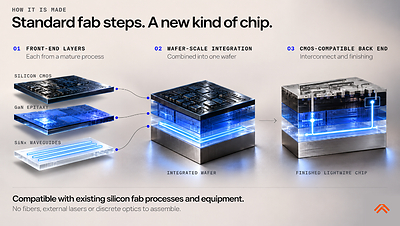
AI chips now compute faster than copper wiring can feed them. Copper’s electrical performance falls a thousandfold between one millimeter and one meter, the distances that connect chips, boards and racks. Staera’s first product, Lightwire, replaces those copper links with light generated inside the chip itself, made with the same process and on the same wafer as the chip’s circuits.

Why light, and why now

AI’s next limit is moving data, not computing it. The International Energy Agency expects data center electricity use to more than double, from about 415 terawatt-hours in 2024 to around 945 terawatt-hours by 2030, and copper wiring cannot carry more data further without burning more of that power. That is pushing the industry’s biggest buyers toward light: Nvidia, which said in 2025 it would “stay with copper for as long as [they] can,” now plans to use both copper and optics in its AI systems. Lightwire is built for that mix.

Light built in, not bolted on

Most optical links today are separate parts, lasers or LEDs made elsewhere and attached next to the chip. Staera fabricates the light source and every other part of a complete optical link inside commercial silicon wafers, making Lightwire the first and only optical interconnect built fully into the chip itself. The links are designed to be made in existing fabs and add no extra size, heat, or power. Staera has built GaN LEDs into silicon chips in commercial foundries since 2016 with processes that now run at 98 to 99 percent yield.

“AI’s bottleneck is no longer how fast chips compute, but how fast and far they can move data,” said Dr Andrew Kim, Chief Executive Officer of Staera. “Copper performance plummets over the millimeter-to-meter distances that matter most in AI accelerators, and bolt-on optics add power and complexity. We build the light into the chip, the entire optical link inside a chip, so the connection gets smaller, cooler and faster with each generation. This funding takes Lightwire from the lab to customers, and the Staera name marks that move.”

Lightwire is built inside the bridge or interposer chip that already connects processors and memory in today’s AI hardware, so it works with existing packaging. Staera designs it to move data using less than a tenth of the energy of today’s best optical links. Moving 24 terabytes of data a second would take under 50 watts with Lightwire, compared with nearly a kilowatt using co-packaged optics.

From lab to customers

The pre-seed round marks Staera’s shift from research to commercial product. The company will use the funding to advance its technology, expand its team, and deepen engagement with its customers and supply chain partners, targeting commercial release in 2030.

“Staera is addressing one of AI infrastructure’s most urgent challenges: moving vast amounts of data between chips without a corresponding rise in power, heat and complexity,” said Hian Goh, Co-Founder, Openspace Capital. “Its ability to build optical links directly into silicon offers a compelling path to faster, more efficient, and more scalable AI systems. We backed Staera because of the strength of its technology, the depth of its team and its potential to define a new category in semiconductor connectivity.”

Staera’s technology has already drawn industry recognition. In May 2026, the company won the 3rd ECTC Start-up Competition at the IEEE Electronic Components and Technology Conference (ECTC), themed “The Light Age: Strategic Investment in Photonics to Power the Next Computing Era.” The same month, it placed runner-up at the 2026 Lam Capital Venture Competition, run by Lam Research in Fremont, California.

Lightwire at a glance

  • 4 to 8 Gbps per link, with more than 600 links per millimeter of chip edge
  • Designed for under 0.2 pJ/bit, against 5 pJ/bit for co-packaged optics
  • More than 100x the performance of electrical links across the millimeter-to-meter range
  • Reaches beyond 50 mm, against 2 mm for UCIe-A die-to-die links
  • Lightwire-based HBM designed to exceed 24 TB/s, against 2.8 TB/s per HBM4 stack today

About Staera Semiconductor

Staera Semiconductor designs the technology that lets modern hardware scale, by carrying data on light instead of electricity. Its LED-based optical interconnect is fabricated inside a single chip, giving AI compute systems the density to move data from millimeters to meters without trading off size, energy or performance.

For more information, visit https://www.staera.ai.

Media contact

Ted Miller
Clario Group
[email protected]

SOURCE Staera

FluxPoint Energy Closes Seed Funding Round to Advance U.S. Uranium Conversion Facility

Experienced nuclear fuel and engineering team advances conversion project to expand domestic production and strengthen America’s nuclear fuel supply chain.

HOUSTON and MCLEAN, Va., Nov. 10, 2026 — FluxPoint Energy, led by industry veterans with decades of experience in uranium processing, nuclear fuel operations and energy infrastructure development, today announced the closing of its seed funding round. The investment supports the engineering, regulatory planning and technical team expansion needed to advance its planned uranium conversion facility toward commercial production.

FluxPoint is developing what it expects to be the first new U.S. uranium conversion facility in almost 70 years. As utilities and developers pursue additional nuclear generation, the company is addressing a fundamental requirement: reliable domestic capacity to process uranium into the material needed for enrichment and subsequent fuel fabrication.

The company’s leadership brings direct experience managing nuclear fuel businesses and delivering complex energy projects. FluxPoint is led by Founder and CEO Mike Chilton who previously served as executive vice president of GE Hitachi Global Nuclear Fuels and president of GE Nuclear Energy’s Joint Conversion Company.

“America’s nuclear ambitions depend on our ability to produce the fuel those reactors will need,” said Chilton. “Our team understands uranium processing and the engineering discipline required to build and operate nuclear fuel infrastructure. Closing this seed round funds the next phase of that work: advancing facility design, preparing for regulatory approvals and building the technical organization needed to deliver domestic production.”

Proceeds will advance front-end engineering design (FEED), support regulatory and permitting activities, and expand the company’s development team. With market and technical feasibility studies completed, FluxPoint is targeting initial commercial production in 2030–2031.

Uranium conversion transforms uranium oxide concentrate, commonly known as yellowcake, into uranium hexafluoride (UF₆), the feedstock used in uranium enrichment. Expanding this capacity in the United States would strengthen a critical link between uranium supply and finished reactor fuel, reducing exposure to foreign processing and supply disruptions.

“Securing America’s nuclear fuel supply requires sustained investment and people who know how to execute,” Chilton said. “This financing supports the detailed technical work that turns a development plan into a facility capable of supplying American customers.”

About FluxPoint Energy

FluxPoint Energy is developing domestic uranium conversion capacity to strengthen America’s nuclear fuel supply chain. Led by experienced nuclear fuel, engineering and energy infrastructure executives, the company’s planned conversion facility will support reliable fuel supplies for existing and future reactors, energy security and long-term U.S. nuclear leadership. For more information, visit fluxpointenergy.com.

Media Contacts: 

Thomas Graham
Crosswind Media & Public Relations
512-537-1414
[email protected]

Chris Rimel | LinkedIn
FluxPoint Energy
[email protected]

SOURCE FluxPoint Energy

Ridero Raises $2.7 Million to Tackle Vehicle Affordability Through AI-Powered Financial Infrastructure

Backed by RiverPark Ventures, NY Ventures, Green Egg Ventures, Blackpoint Capital, and Potamkin Ventures, Ridero is expanding access to flexible vehicle financing.

NEW YORK, Nov. 9, 2026 — Ridero, an AI-powered automotive financial infrastructure company, today announced $2.7 million in total pre-seed funding, with backing from RiverPark Ventures, NY Ventures, Green Egg Ventures, Blackpoint Capital, and Potamkin Ventures.

The funding will accelerate Ridero’s mission to address the growing vehicle affordability crisis by enabling financial institutions and automotive retailers to offer more flexible financing options at scale.

As vehicle prices and financing costs continue to pressure American households, traditional automotive financing products have struggled to keep pace with changing consumer needs. Ridero is building the technology infrastructure to expand access to alternatives to conventional auto loans, including new- and used-vehicle leasing and balloon financing.

“Millions of vehicles have historically been difficult to lease because the financial infrastructure needed to support them at scale hasn’t existed,” said Brock Thompson, Co-Founder and CEO of Ridero. “We’re building that infrastructure to give lenders and dealers more ways to make vehicles affordable and accessible,” said Natalie Williams, Co-Founder and CTO of Ridero.

Ridero’s platform combines AI-powered deal structuring, risk analytics, and automated lender connectivity to help financial institutions launch, distribute, and manage residual-based financing products.

The company’s technology is already in use at dealerships across the Northeast and Southern United States. Ridero has also established a strategic partnership with Auto Financial Group (AFG) to expand access to residual-based financing products and integrated with Tekion to bring its financing capabilities into existing dealership workflows.

Ridero is advancing additional strategic partnerships and technology integrations with financial institutions and automotive technology providers.

The funding will support continued product development, expansion of institutional partnerships, and growth of Ridero’s team.

About Ridero

Ridero is an AI-powered financial infrastructure company modernizing automotive finance. Its platform connects financial institutions and automotive retailers, enabling the launch, distribution, and management of flexible vehicle financing products, including new- and used-vehicle leasing and balloon financing.

Ridero was founded by Brock Thompson and Natalie Williams, who bring complementary backgrounds in institutional investing and artificial intelligence. Thompson previously worked at The Carlyle Group and The Amherst Group, while Williams came from Capstone Investment Advisors and UBS. Both founders attended Columbia University together.

Website: ridero.ai

SOURCE Ridero

Qloo Names Undertow Winner of Global Agentic Hackathon

NEW YORK, Nov. 9, 2026 — Qloo, a leading artificial intelligence company providing taste intelligence for AI agents and consumer experiences, today announced Undertow as the winner of its Global Agentic Hackathon, which drew nearly 3,000 developers worldwide. Investor Jason Calacanis pledged to invest $25,000 in Undertow during the November 5 finals on This Week in Startups.

Iowa’s Senate upset, which helped Democrats retake the U.S. Senate in the November 3 midterms, offers an early look at what local cultural data could add to election forecasting. Ahead of Election Day, Undertow’s polling-only forecast narrowly favored Republican Ashley Hinson. With Qloo’s local cultural preference data added, Undertow picked Democrat Josh Turek, who won the race.

Engineer Abdal Hassani built Undertow using Qloo’s taste data to create county-level profiles and learn how those profiles aligned with 2020 voting results. For the 2026 midterms, Undertow combined its county estimates into state-level forecasts and blended them with public polling. In Hassani’s preliminary evaluation of 33 Senate races called by midday November 4, the combined forecast correctly picked 32 winners, compared with 31 for Undertow’s polling-only forecast. Hassani said both forecasts were published before Election Day. The race-by-race results are available in Undertow’s scorecard.

“I built Undertow with Qloo’s taste data to test a simple question. Could what people watch, where they eat and the brands they like add something useful to an election forecast?” said Abdal Hassani, CEO at Undertow. “Iowa was where that extra context changed our pick.”

Undertow uses Qloo’s API to identify local preferences without requiring personal information. During the finals, Calacanis and fellow judge Cedric the Entertainer discussed how the same capability could help advertisers decide where to spend, and tour managers choose which cities to visit.

“Abdal got my attention with the Iowa call. What made me want to invest was how quickly I could see the idea working beyond elections,” said Jason Calacanis. “If you’re deciding where to spend an ad budget or which cities to put on a tour, understanding what people in those markets care about can change the decision.”

“AI is learning to reason, plan, and act. The less we want to instruct our agents, the more they need to understand us,” said Alex Elias, founder and CEO of Qloo. “Undertow shows how a developer can take that foundation into an entirely different field and make it measurable.”

Qloo works with companies including American Express, Netflix, Match Group, Live Nation and Michelin. Its taste intelligence powers recommendations, personalization and audience insights across industries.

About Qloo

Qloo provides taste intelligence for AI agents and consumer experiences. Its APIs draw on more than 600 million entities across entertainment, dining, travel, fashion, brands and consumer products to power recommendations, audience insights and personalization. Learn more at qloo.com.

Media Contact: kathy osborne, [email protected]

SOURCE Qloo Inc.

NAVER D2SF-backed MOVIN Raises KRW 10 Billion Series A to Expand from Motion Capture to Motion Data Infrastructure

  • MOVIN TRACIN reaches KRW 1 billion in global revenue within a year of launch, with expansion into robotics, live entertainment, sports and rehabilitation
  • MOVIN extends its technology from ultra-light devices to large-space, multi-person environments and plans to build a 330㎡ R&D center

SEOUL, South Korea, Nov. 9, 2026 — NAVER D2SF-backed MOVIN, a LiDAR-based 3D motion data AI company led by CEO Byeoli Choi, has raised KRW 10 billion in a Series A round. The round was led by IMM Investment, with participation from Industrial Bank of Korea (IBK) and Voyager Ventures. Existing investors Atinum Investment, NAVER D2SF, and Schmidt also made follow-on investments. This marks NAVER D2SF’s third consecutive investment in MOVIN, following its seed investment in 2023 and the pre-Series A round in 2025. With the new funding, MOVIN plans to grow its motion capture business and build an R&D center of approximately 330 square meters to strengthen its technology development in physical AI.

Founded in 2023, MOVIN develops technology that converts human movement into precise 3D data. Its flagship solution, MOVIN TRACIN, combines LiDAR sensors and camera vision with the company’s proprietary AI to capture movement in real time without suits or markers, replacing the complex setup and reducing the cost associated with conventional motion capture equipment. Building on this, MOVIN has secured global customers primarily in content production, including games, film, and virtual creators. Within a year of the product’s commercial launch, overseas sales accounted for 70% of total revenue, reflecting growing demand in international markets.

Building on its core technology, MOVIN is developing industry-specific solutions to address evolving market needs. Global robotics companies and research institutes such as Boston Dynamics and the RAI Institute have used MOVIN’s technology for robot teleoperation and training, and MOVIN TRACIN Lite, is being used by partners to collect human motion data for robot learning.  MOVIN was also selected as the only South Korean Launching Adoption Partner for NVIDIA SOMA, integrating its technology to support robot learning with real-world human motion data. In live entertainment, MOVIN unveiled MOVIN TRACIN Stage, which tracks the movements of multiple performers simultaneously, at the 2026 NAB Show in the U.S. this April, where it also demonstrated integrations with Disguise and Notch. Based on these use cases, MOVIN plans to expand into live interactive content and shows, as well as sports, rehabilitation, and other industries that utilize human movement as data.

MOVIN, which raised a KRW 4 billion pre-Series A round last year, plans to use the new funding to advance its technology and grow its global business. Starting with MOVIN TRACIN, its single-person markerless motion capture solution, the company plans to extend its technology into on-device multimodal AI-based motion data infrastructure that supports everything from ultra-light devices to large-space, multi-person environments.

MOVIN is also expanding its R&D infrastructure. The planned R&D center will focus on collecting real-world multimodal datasets for world-model development and advancing MOVIN’s AI and motion data processing technologies.

“AI is moving beyond understanding text and images toward understanding and learning from movement in the real world,” said Byeoli Choi, CEO of MOVIN. “Having seen the potential of our accessible motion capture technology in the global market, we will continue growing our content and entertainment business while building the motion data infrastructure the physical AI era needs.”

SOURCE NAVER D2SF