Leading MIT computer vision engineer turns lessons from his family’s factory floor into material savings for major manufacturers including Amcor, Consolidated Industries, Klöckner Pentaplast and DuPont
CAMBRIDGE, Mass., Nov. 12, 2026 — Tristar AI, the real-time intelligence layer for the factory floor, today announced $12.4 million in Series A funding. The round was led by Isogon Ventures, with participation from Blackhorn Ventures, Ford Street Ventures, ISAI Cap Venture, Capgemini’s VC Fund managed by ISAI, Las Olas VC, NextView Ventures, Seraph Partners, SNR Ventures and TenOneTen. Tristar will use the funding to continue investing in its industry-leading AI vision and edge computing platform, expand into additional manufacturing sectors, scale its customer success and deployment teams to support multi-site enterprise rollouts, and grow its sales and marketing teams to meet growing demand from manufacturers looking to put skilled workers on their most valuable tasks and protect margins.
“I grew up in my family’s plastic-film plant. I remember going in with my dad at odd hours to fix costly errors that could erase a month’s margin if they weren’t caught right away. My dad spent decades working to get it right, so I’ve dedicated myself to building technology that catches those problems early,” said Salem Karani, CEO and co-founder of Tristar AI. “The problem was never that people didn’t care about quality. It’s that people catch problems after the fact, once they’ve already cost time, materials and customers. Tristar gives every line a live record, so teams can act when it matters most. That’s why our customers expand from single lines to entire plants and across locations. This funding lets us serve more manufacturers, more industries and more people who want their products made right the first time.”
Manufacturers face a persistent labor shortage, rising quality expectations and higher material costs, all while working to bring more production back home. According to the Capgemini Research Institute, 48% of U.S. organizations have invested in reshoring initiatives in 2026, up from 30% in 2025, while 83% of organizations report that shortages of skilled industrial workers pose a significant challenge to their reindustrialization efforts. At the same time, legacy inspection protocols take talent off the line while still too often letting quality issues go undetected, resulting in scrapped materials, labor lost to rework and avoidable downtime, and customer claims that impact both the bottom line and reputation.
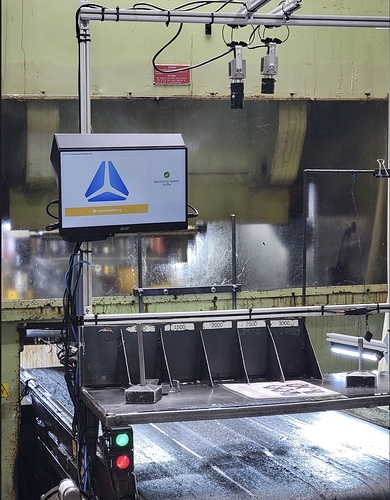
Tristar uses AI-powered visual inspection to identify defects as materials move through manufacturing lines. Unlike traditional machine vision systems built around fixed rules, Tristar’s AI models can adapt across products, defect types and changing production conditions. The platform connects machine performance, product quality and operator activity to help manufacturers understand not only when something goes wrong, but where and why.
Operators get immediate feedback, while supervisors and plant leaders see trends, production performance and ROI across lines and facilities. The platform integrates with the cameras, PLCs, sensors, MES, ERP and maintenance systems manufacturers already use, so there’s no need to replace existing technology.
“We’ve seen too many manufacturers lose money to defects, or delay a shipment that ends up stopping a customer’s plant,” said Paco Riberas, General Partner of Isogon Ventures. “In today’s industry, precision isn’t optional, and Tristar makes it possible: its AI vision catches defects in real time, directly on existing lines. We believe Salem and the team are building the quality standard for modern manufacturing.”
Today, Tristar’s AI inspects hundreds of billions of dollars’ worth of products that Americans use every day, across more than 500 production lines in North America and Europe. Its customers range from the largest suppliers for Toyota, Honda and Mercedes to manufacturers representing more than half of the plastics and film market, companies for whom a single quality escape can cost millions. Live deployments report 95–99% defect-detection accuracy, and the platform typically pays for itself in about four months.
That impact is driving fast growth, with Tristar expanding more than fourfold over the past year.
“This investment reflects our strong conviction that physical AI will play a critical role in the future of manufacturing,” said Matthieu Eyriès, Managing Director, Capgemini Ventures. “Tristar combines advanced AI capabilities with a strong understanding of industrial environments, addressing concrete manufacturing challenges with measurable impact. We are proud to support the company through our ISAI Cap Venture fund as it enters its next phase of growth and scales its technology across the manufacturing sector.”
Looking ahead, Tristar aims to become the system of record for factory operations, giving manufacturers a continuous view of quality and production from incoming raw materials through final shipment.
About Tristar AI
Tristar AI helps manufacturers catch defects in real time. Its AI vision platform inspects products as they move through production, alerts operators to quality issues within seconds, and gives quality teams and plant leaders visibility across lines and facilities. Tristar integrates with existing cameras, PLCs, robotics, sensors, MES and ERP systems, and serves manufacturers in automotive, plastic film, injection molding and packaging across North America and Europe. Founded by CEO Salem Karani, Tristar is based in Cambridge, Massachusetts. Learn more at tristar.ai.
Media Contact
SOURCE Tristar AI
